Dunstable Futures: from respectably vague to commercially credible.
Dunstable Futures came to us with a visual identity and website presence that looked competent in a broad, slightly non-committal way. Our job was to sharpen the proposition, modernise the presentation, and create a brand experience that felt more like a real financial services firm and less like an open-ended thought exercise.
A financial services brand that needed less atmosphere and more authority.
Dunstable Futures had the familiar symptoms of a business that wanted to sound modern, reassuring, and strategically aware all at once. The problem was that the existing presentation landed somewhere between generic consultancy language and a stock-photo promise that nobody could be expected to remember five minutes later.
The original site was not disastrous. In fact, that was part of the problem. It looked polished enough to avoid immediate alarm, but vague enough to leave visitors with no clear sense of what the company actually did, why it mattered, or whether anyone inside it had ever made a firm decision.
Our role was to reposition the business visually and verbally so it felt clearer, more assured, and more commercially grown up. In practice, that meant reducing the ambient optimism, tightening the narrative, and replacing “future-facing possibility language” with something sturdier.
- Brand positioningClarifying the promise, tone, and market stance without lapsing into financial wallpaper.
- Homepage strategyRestructuring the entry point so the business appeared legible, confident, and less abstract.
- Messaging refinementRemoving soft, non-committal wording and replacing it with cleaner, firmer language.
- Visual directionShifting the look and feel toward credibility, maturity, and actual presence.
- Case-study shapingTurning the final outcome into something worth showing off on this website, which is what you are reading now.
Same company. Noticeably less drift.
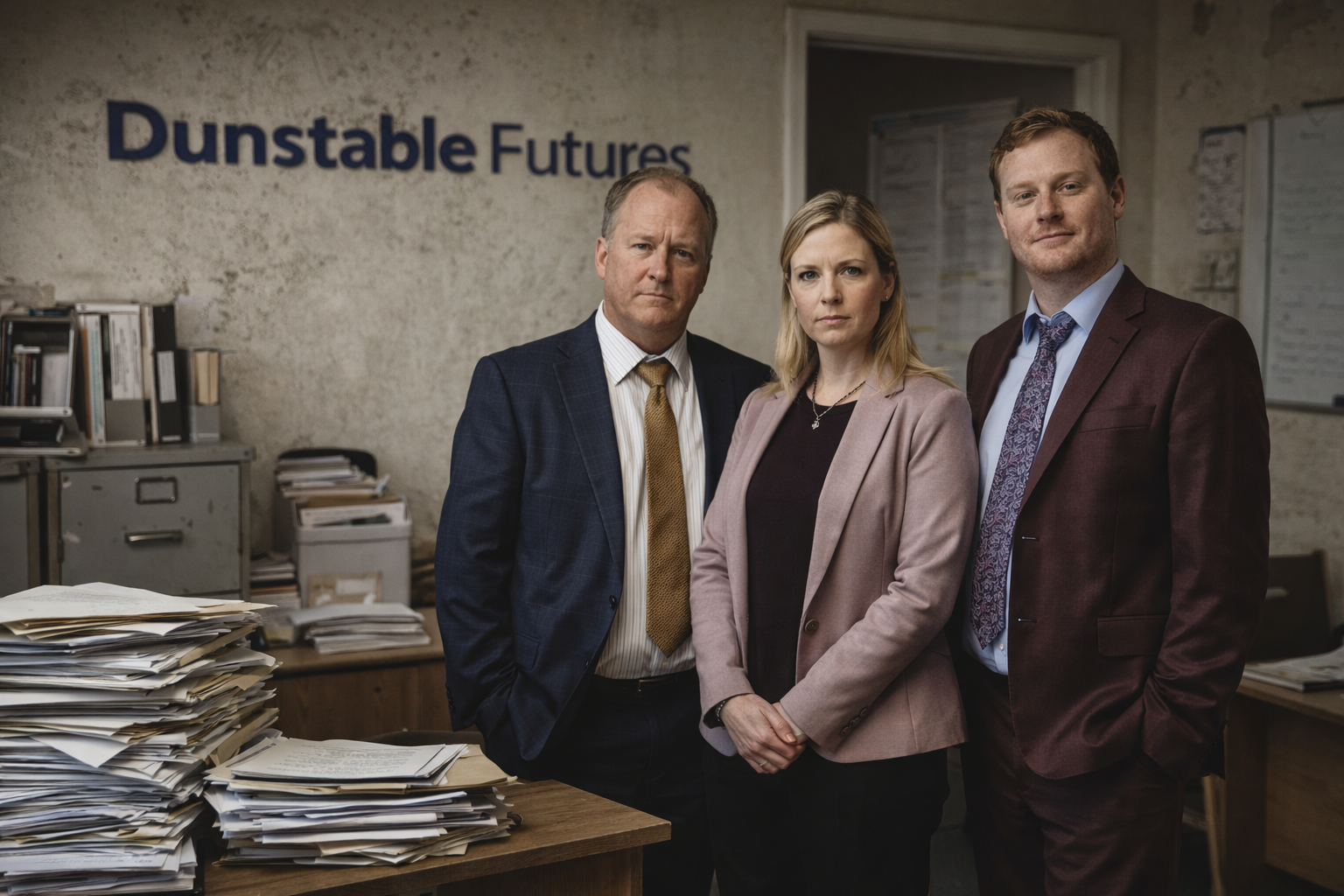
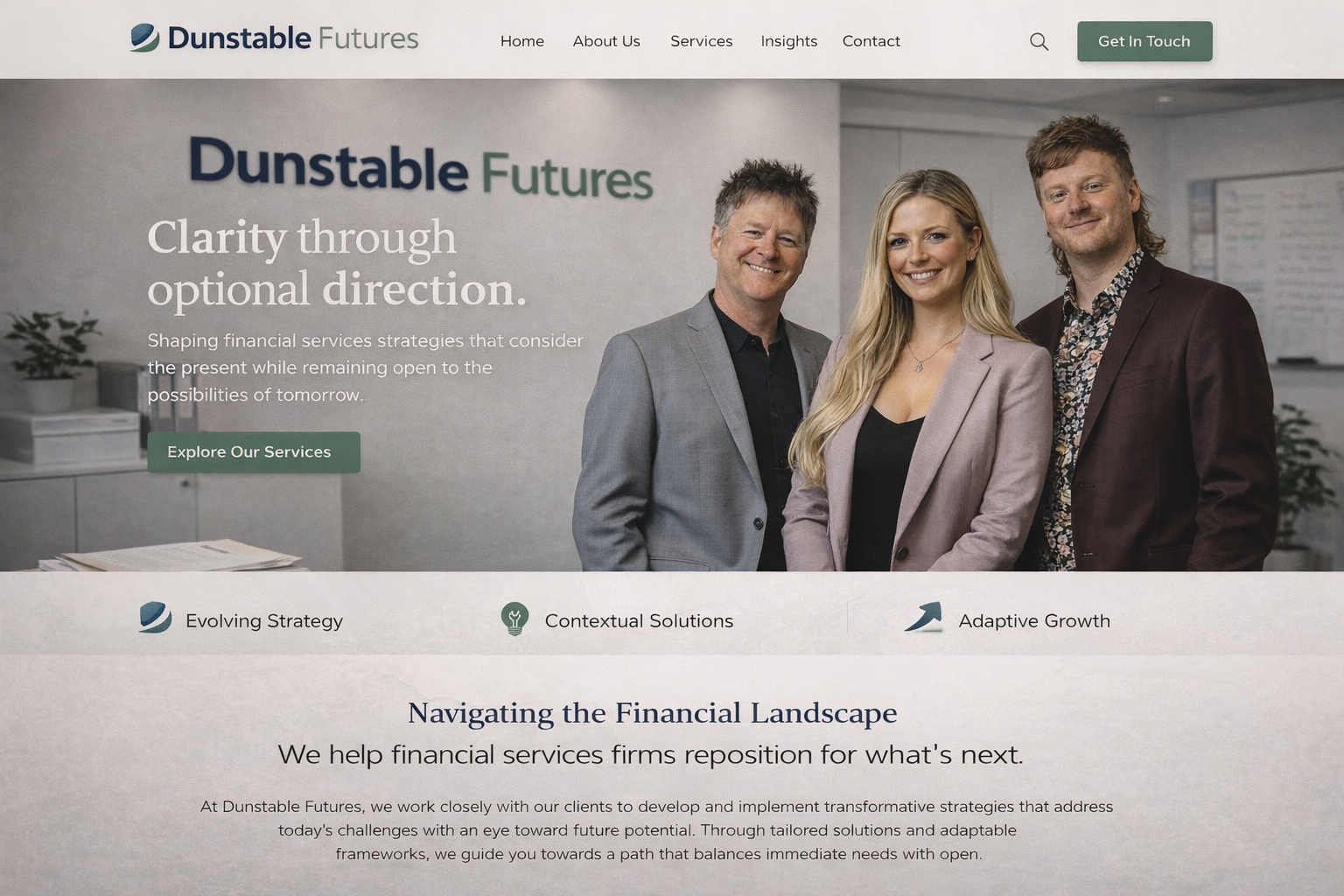
The easiest way to understand the project is simply to look at the shift. Before, the brand suggested “clarity through optional direction,” which is the kind of phrase that sounds thoughtful until you sit with it for more than seven seconds. After, the business looks more serious, more focused, and vastly less likely to describe its own strategy as a weather pattern.
The brand was not broken. It was simply saying nothing with considerable confidence.
The problem
Dunstable Futures looked like many mid-market professional services brands look when nobody has forced a difficult conversation in a while. The design was neat. The faces were friendly. The words were arranged in the correct order. Yet almost everything important remained indistinct.
There was no immediate hook, no proper commercial edge, and no firm sense of why a potential client should trust this business over another one making identical claims about guidance, possibility, and tomorrow.
In short, the existing presentation was not a disaster. It was something arguably worse: acceptable.
Our response
We reframed the business around a more credible tone and a more grounded visual language. The goal was not to make it louder. It was to make it read like a business with a point of view.
That meant moving away from generic future-speak and toward a more serious, assured presence. We wanted the team to look less like participants in a regional leadership brochure and more like people entrusted with consequential decisions.
The result is a brand presentation that feels more direct, more adult, and less likely to evaporate from memory the moment the tab is closed.
Measured outcomes, observed improvements, and a dramatic drop in strategic mist.
Some of the impact here is quantitative. Some is qualitative. All of it points in the same direction: the business now presents itself with greater clarity, stronger differentiation, and a considerably lower risk of sounding like it was assembled from generic LinkedIn adjectives.
A full repositioning package, minus the ceremonial jargon and moodboard overgrowth.
This was not just a visual clean-up. The work covered strategy, language, structure, and presentation, all aimed at making Dunstable Futures feel more like a real commercial proposition and less like an aspirational holding statement with excellent lighting.
Strategic foundation
We revisited the underlying narrative and clarified what the business needed to communicate in order to sound purposeful rather than merely agreeable.
- Positioning review
- Value proposition shaping
- Tone recalibration
- Audience-facing narrative
Website messaging
The homepage and supporting copy were reworked to be cleaner, firmer, and less dependent on floaty strategic phrases that dissolve under scrutiny.
- Homepage rewrite
- Headline refinement
- Service message hierarchy
- CTA clarity improvement
Visual repositioning
We guided the visual shift toward something more grounded and credible, with a stronger sense of seriousness and less brochure-adjacent optimism.
- Imagery direction
- Presentation tone upgrade
- Sharper overall atmosphere
- More convincing leadership presence
Audit
We reviewed the existing site, tone, visuals, and overall impression to identify where the brand felt polished but indistinct.
Reframe
We clarified the strategic story and replaced broad, non-committal positioning with language that could carry actual meaning.
Rebuild
The website presentation, structure, and visual emphasis were reshaped to support a more credible and more memorable identity.
Release
The final output gave the business a stronger public face and a clearer internal sense of what it was trying to be.
What changed, in terms nobody had to squint at.
The outcome
Vaguely Strategic took a brand that looked fine on paper and turned it into something that actually felt believable. The difference was not just aesthetic. The business now sounds more certain, more focused, and much easier to explain without drifting into abstractions.
More projects where we improved matters without making a performance of it.
If this kind of transformation is your thing, there are several other examples in the archive, each involving a similar mix of strategic tightening, language repair, and quiet commercial rescue.
Need your brand to look less acceptable and more convincing?
If your website feels polished but vague, calm but forgettable, or strategically impressive in a way nobody can quite explain, we should probably talk.
Before and after not guaranteed. Improvement, however, remains a central ambition.