Professor Robert
Moonbeam Sebastian Fork
b. 1943, location disputed, possibly twice
Founding figure of Astrocosmicology. Originator of the Forkian Harmonic Model. Classmate of Jim Morrison at minimum, and according to a committed academic minority, the same person. Currently Chair of AstroCosmicology at the Institute for Strategic Celestial Inquiry, which has been renamed eleven times for reasons he describes as energetic repositioning.
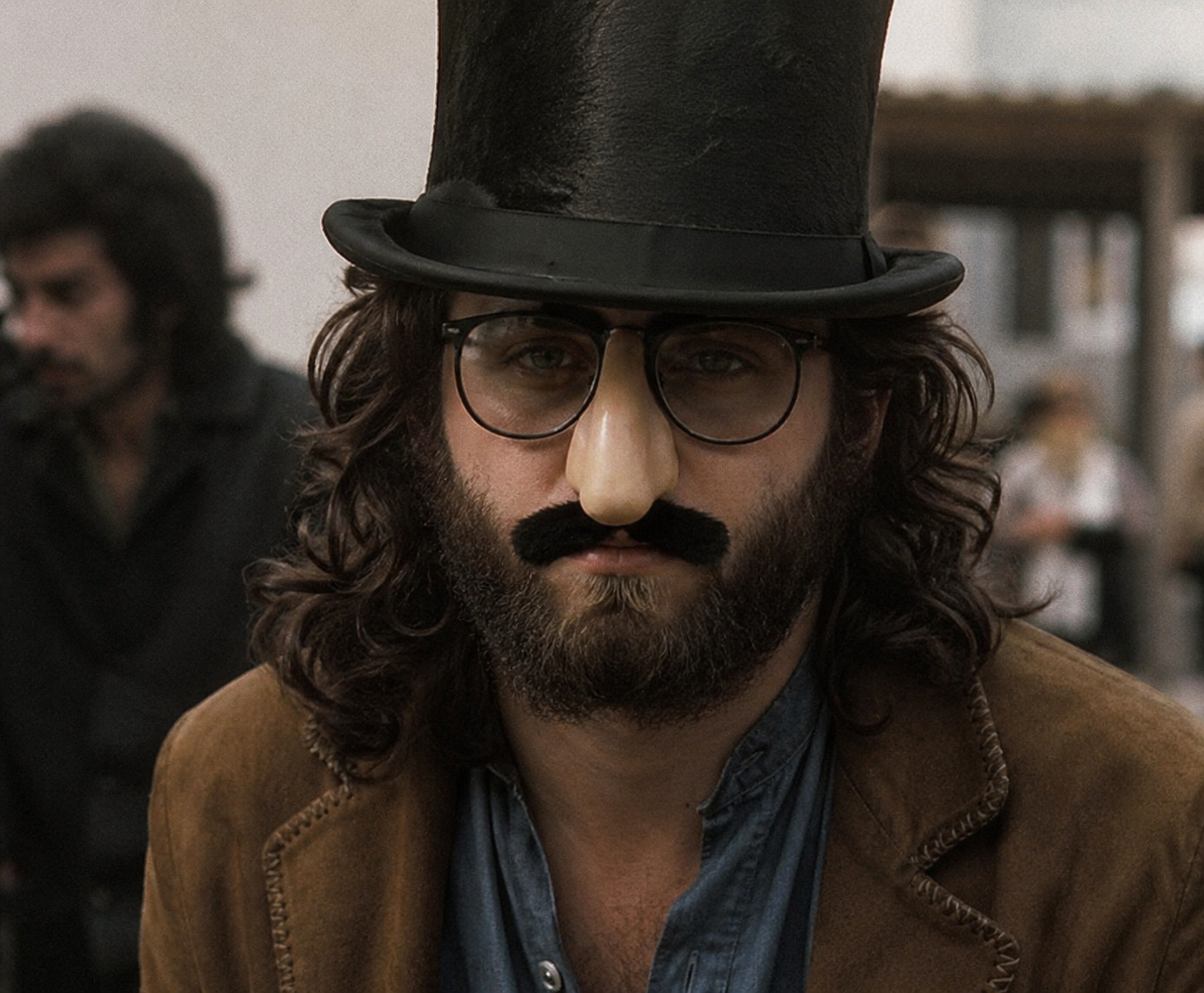
Professor Fork photographed at the Institute, date unclear. The filing cabinet visible in the background is labelled DO NOT OPEN UNTIL AFTER THE NEXT RETROGRADE. It has not been opened.
The man who decided the stars had commercial opinions and spent forty years proving it.
Professor Robert Moonbeam Sebastian Fork (b. 1943, location disputed, possibly twice) is widely regarded as the founding figure of Astrocosmicology, the interdisciplinary field examining how celestial drift influences organisational behaviour, brand resonance, and the strategic psyche of late-stage capitalism. He is also, depending on who you ask, a visionary, a fraud, a national treasure, and Jim Morrison.
Fork's early life is shrouded in the kind of ambiguity he later described as "methodologically essential, and also useful." What is known is that he attended the same universities, in the same years, as Jim Morrison: St. Petersburg Junior College, Florida State University, and UCLA. Whether this was coincidence, destiny, or a very long administrative error has never been satisfactorily resolved.
Fork refuses to clarify his relationship with Morrison. When pressed, he has offered only that some friendships are best understood as parallel timelines, and then stared at the ceiling for slightly too long. A smaller, more committed group of scholars insists there was no relationship because Fork and Morrison are the same person, and that the poet faked his death in Paris in 1971 in order to pursue a quieter life in academic celestial brand consultancy.
Fork has neither confirmed nor denied the Morrison theory. He has, however, been heard humming The End during conference coffee breaks, twice in the middle of someone else's presentation, and once, reportedly, during a client onboarding call. The client later described the experience as "unexpectedly atmospheric."
It was during this period of what Fork calls "artistic and intellectual cross-pollination," and what a 1968 UCLA faculty memo calls "frankly concerning behaviour," that Fork first articulated the phenomenon now known as Astrocosmic Brand Drift. According to his own notes, archived controversially in a fireproof cabinet labelled DO NOT OPEN UNTIL AFTER THE NEXT RETROGRADE, the insight arrived during a late-night conversation about the gravitational pull of cultural archetypes, the marketing potential of lunar cycles, the way audiences orbit charismatic figures, and, in Fork's own words, "whatever Jim had been smoking, which was considerable."
Fork described the moment as a harmonic convergence. His landlord described it as a noise complaint.
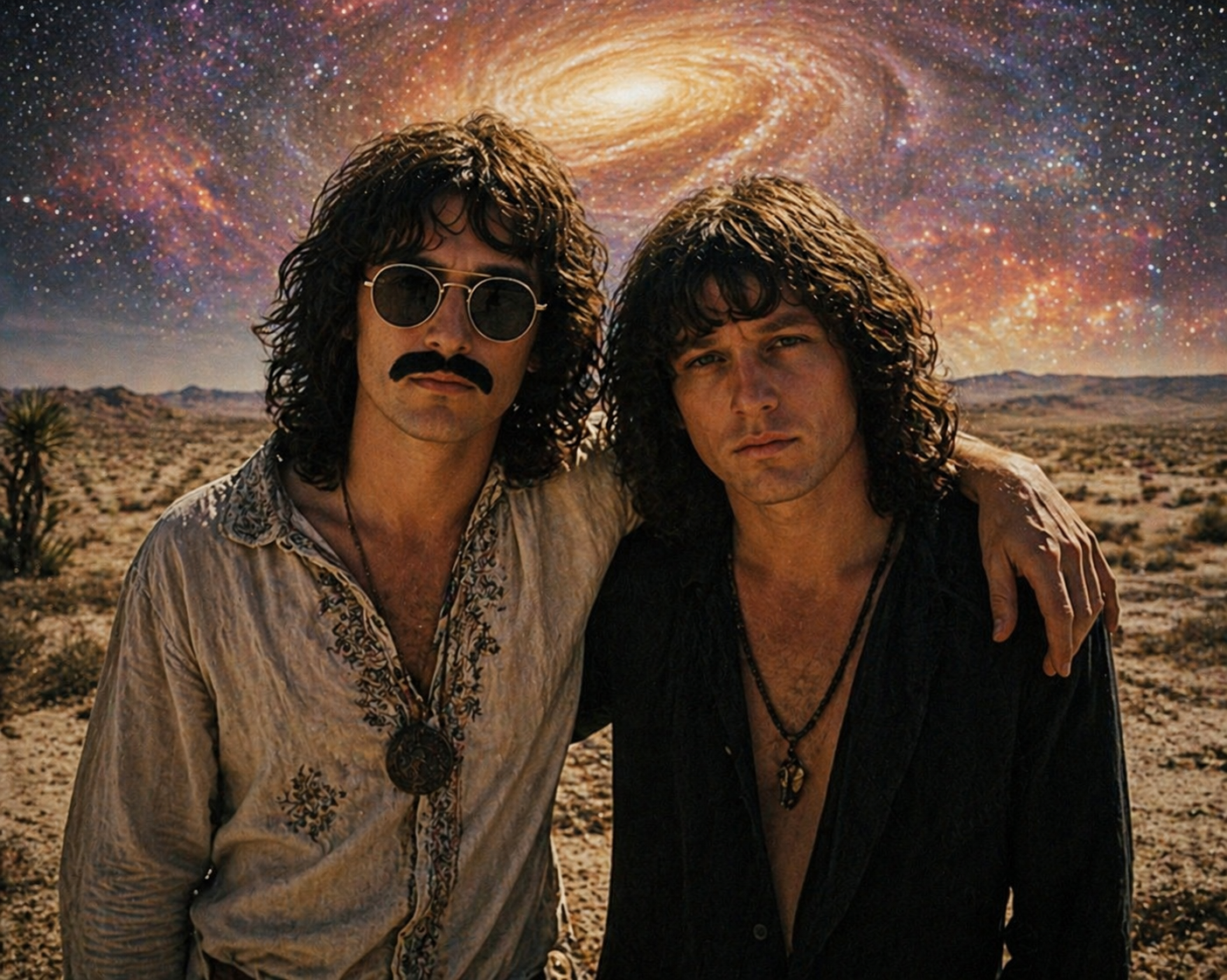
Archival photograph, date unclear. The figure on the left is consistent with known depictions of Jim Morrison. The figure on the right has not been formally identified, though several scholars note that the briefcase is labelled R.M.S. Fork. Fork's response when shown this photograph was to look at it for a long time and then say "the desert is a good place to think." No further comment was provided.
The academic community's most discussed non-answer since 1971.
Fork refuses to clarify his relationship with Morrison. When pressed, he has offered only that "some friendships are best understood as parallel timelines," and then stared at the ceiling for slightly too long. A smaller, more committed group of scholars insists there was no relationship because Fork and Morrison are the same person, and that the poet faked his death in Paris in 1971 in order to pursue a quieter life in academic celestial brand consultancy.
The circumstantial evidence is, at minimum, atmospheric. Both men attended the same three universities in the same years. Both were described by contemporary accounts as "difficult to locate on a Thursday." Both have been photographed in deserts, though Fork insists his were fieldwork. The photograph on the left is not confirmed. Nothing has been confirmed. This is, Fork has noted, consistent with the nature of the field.
Vaguely Strategic™ does not hold an official position. We note that Position B is where the most interesting work lives and that Position C would, if true, represent the most dramatic personal rebrand in marketing history. We respect that.
Lectures on topics that have a four-year waiting list and never start on time.
Orbital Consumer Behaviour
An examination of how celestial mechanics shape purchasing decisions, brand loyalty, and the timing of unsubscribes. Students are required to chart their own sign and submit a reflective essay on whether it explains their last three career moves.
The Semiotics of Retrograde
What Mercury Retrograde means, why it means it, and how to deploy the language of retrograde in a client meeting without technically claiming anything that can be fact-checked. A popular module. The exam is held during Mercury Direct.
Brand Resonance in the Orion Drift
A deep exploration of why campaigns launched during Orion–Leo whooping windows outperform those launched outside them, and what this tells us about either the cosmos or confirmation bias. Fork considers the distinction unimportant.
The Ethics of Interplanetary Positioning
Can a brand ethically claim celestial alignment it has not earned? What does it owe audiences who plan campaigns around its guidance? Fork teaches this module with visible discomfort and occasional long pauses that he calls "contemplative orbit."
Spoon Theory and Stakeholder Behaviour
The foundational module on symbolic interference. Students learn to identify spoon volatility events, distinguish them from genuine strategic disruption, and present both options in the same deck without the client noticing the difference.
Thursday: Star or Instinct?
An elective exploring the Thursday Dispatch Effect in full. Why has the belief that something should go out on Thursday persisted across four decades of data? Is Thursday cosmically significant? Fork's answer changes annually and is considered part of the course.
The Institute for Strategic Celestial Inquiry, currently.
Fork currently serves as Chair of Astrocosmicology at the Institute for Strategic Celestial Inquiry, an institution that has been renamed eleven times for reasons Fork describes as "energetic repositioning" and his colleagues describe as "planning permission issues, primarily."
The Institute was founded in 1973 under a name that was immediately changed. It has since operated under eleven distinct identities, each reflecting, according to Fork, "a shift in celestial emphasis." The current name has been in use since 2019 and is considered by most faculty to be the most stable iteration so far, though Fork has been seen examining the signage thoughtfully.
The Institute's annual conference is known for its excellent catering, its willingness to accommodate very long questions from the floor, and the fact that it never begins on time due to what the programme notes describe as "a persistent Mercury situation that we are monitoring."
Current name in use since 2019. Fork has been seen examining the signage. No announcement is forthcoming. The faculty have been through this before.
Celestial residence
Fork lives quietly under the Leo-Orion Moon with his spouse, whose identity is also a matter of scholarly dispute. Fork has described his home as "a good place to think" and has not elaborated. The precise location is unknown. Colleagues believe it is somewhere in the South West.
Digital presence
Fork does not have a social media presence. Several accounts claim to be him. He considers all of them "directionally accurate" and has expressed no desire to clarify the situation. One account has 4,200 followers and posts exclusively about spoon sightings. Fork follows it.
Musical affiliations
Fork has been observed humming The End at conferences, during presentations, and on at least one client onboarding call. When asked about this, he has said only that it is "a useful reference point" and changed the subject. The humming is consistent across decades.
Read the study that Fork helped make possible.
The AstroCosmic Alignment Marketing study synthesises forty years of observational work into five actionable principles, a zodiac appendix, and a spoon volatility index that has never once been wrong in a way that is easily verifiable.
The study is free. Fork did not ask for royalties. He asked only that it be released during a favourable orbital window, which we respected.