MercuryLane
Repositioning a behavioural advertising firm from “slightly intrusive” to “elegantly unsettling”, using premium monochrome visuals, psychological terminology, and a level of audience insight that would make a smart fridge feel watched.
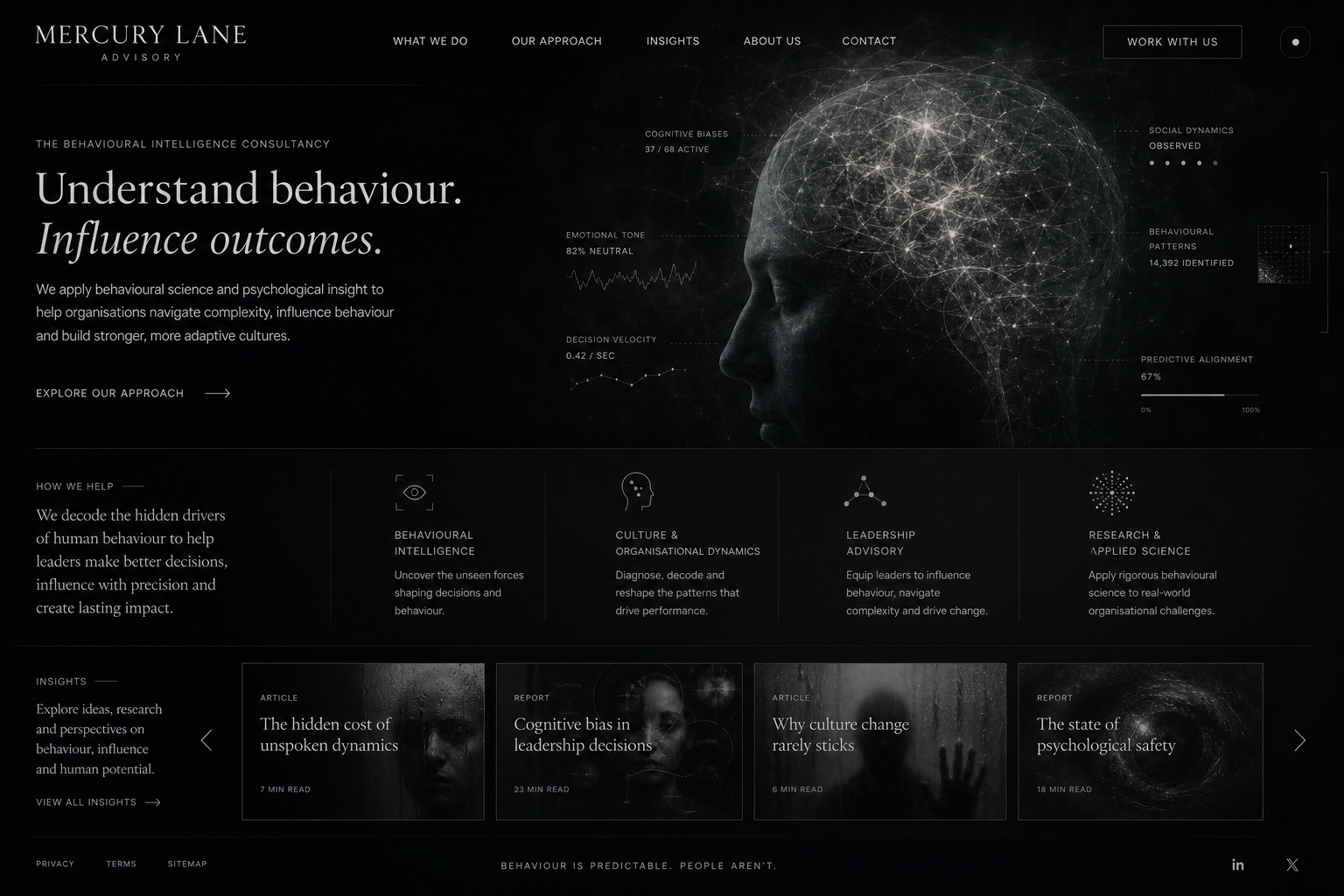
Too much data. Not enough theatrical unease.
Mercury Lane came to us with a common problem: they knew everything about their audiences, but they were still describing this as “marketing”. We identified an immediate opportunity to elevate the brand into something more premium, more ominous, and far less likely to be understood by procurement.
The Brief
Mercury Lane needed a sharper market position for its behavioural advertising offer, one that communicated intelligence, sophistication, and a worrying amount of confidence around consumer predictability.
The existing messaging focused on targeting, segmentation, and campaign optimisation. Functional, yes. Disturbing, no.
Our Diagnosis
The brand was suffering from what our internal team classified as “insight modesty”. This occurs when a company has enough audience data to construct a personality replica, but still insists on saying things like “relevant content”.
- Problem oneThe language sounded too reasonable.
- Problem twoThe visuals lacked sufficient brain-adjacent intimidation.
- Problem threeThe client was using the word “personalisation” when “predictive behavioural leverage” was available.
We made the algorithm look like it had opinions.
Our visual direction combined neuro-marketing aesthetics, surveillance-adjacent interface design, grayscale medical imagery, and the sort of copy that sounds like it came from a strategy deck left behind in a windowless room.
The resulting identity communicates what Mercury Lane does in a way that is simultaneously impressive and inadvisable to read aloud in a client meeting without first checking who else is in the room.
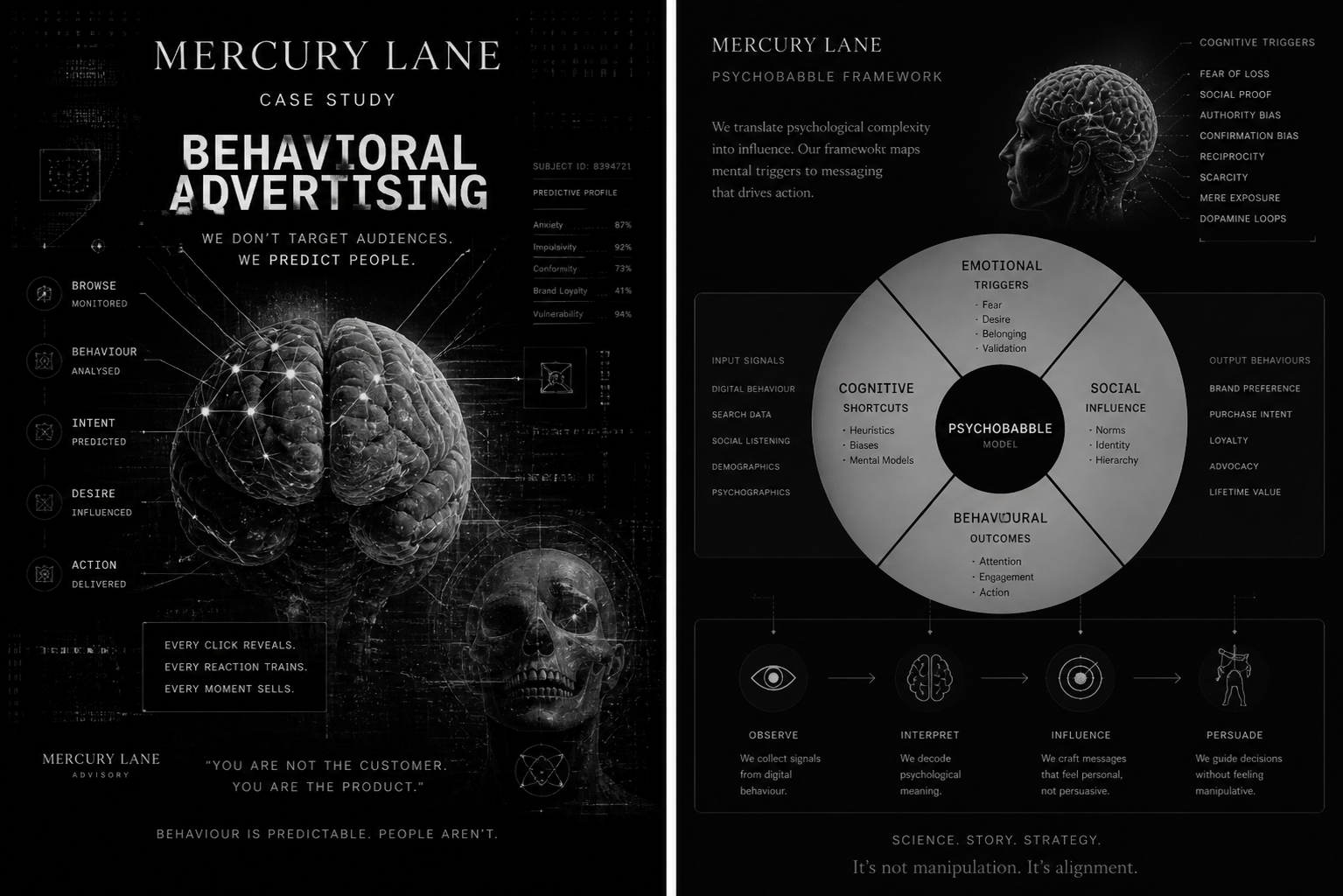 Behavioural advertising, now with 47 per cent more brain.
The Cognitive Resonance Influence Architecture™
At the core of the Mercury Lane repositioning is what Vaguely Strategic™ developed as the Cognitive Resonance Influence Architecture™ (CRIA™) — a multi-layered behavioural intent mapping system that identifies, scores, and amplifies the invisible motivational substrate beneath every consumer micro-moment. In practical terms, this means we built a diagram with six sections and named everything twice.
Each consumer touchpoint is assigned a proprietary Intent Resonance Score (IRS™) derived from dwell patterns, micro-hesitation analysis, and what our data team refers to as “the ambient digital nervous system.” IRS™ ranges from 0 (actively hostile) to 100 (worryingly ready to purchase).
Standard demographic segmentation is replaced with Compressed Psychographic Archetypes (CPAs™) — deep personality constructs derived from browsing cadence, emoji selection patterns, and the specific moment at which a user exits a checkout flow without explanation.
Mercury Lane’s campaigns operate within a proprietary Emotional Latency Window (ELW™), defined as the six-to-eleven second period following a brand exposure in which the consumer is most susceptible to what our framework calls “aspirational surrender.”
Using a blend of contextual targeting, inferred emotional state, and barometric pressure data from three cities in the East Midlands, Mercury Lane’s Desire Signal Amplification layer ensures that messaging arrives at the precise moment of maximum receptivity, or close enough.
Through repeated, strategically timed exposure across owned, earned, and paid channels, Mercury Lane establishes what CRIA™ terms a Subconscious Brand Anchor (SBA™) — a persistent neural association between the client brand and whatever emotion the consumer was experiencing the third time they saw the ad.
Once a conversion is achieved, Mercury Lane deploys its Post-Conversion Resonance Protocol (PCRP™) to consolidate the emotional transaction and prevent what internal documentation describes as “buyer’s clarity” — the dangerous moment when a consumer thinks carefully about what they just agreed to.
The Psychobabble Influence Model™
To help Mercury Lane explain its offering without saying anything legally inconvenient, we developed a proprietary strategic framework based on behavioural cues, inferred intent, emotional triggers, and several phrases that became less meaningful the longer we looked at them.
Observe
Monitor audience behaviours across channels, moments, devices, impulses, pauses, scrolls, hesitations, and suspiciously long basket visits.
Interpret
Translate fragmented behavioural signals into rich psychological profiles using inference, confidence scoring, and a graph with a circle in it.
Influence
Craft messaging that feels personal, timely, and faintly as though it knew what you were thinking before you did.
Reassure
Describe the entire process using soft language such as alignment, relevance, and customer experience.
“You are not the customer. You are the product journey.”Mercury Lane, after three workshops and one dimly lit breakout session
A full repositioning built on fear, polish, and plausible terminology.
The scope of this engagement was agreed verbally across two meetings and one follow-up message that was subsequently marked as read but not responded to for eleven days. What follows is our best reconstruction of the deliverables, cross-referenced against three invoice line items and a shared folder that was last accessed in March.
| Deliverable | What it did | Why it sounded important |
|---|---|---|
| Behavioural Advertising Visual System | Established a premium black-and-white identity using brains, data lines, interface fragments, and scientific unease. | Looked expensive, difficult to question, and probably GDPR-adjacent. |
| Cognitive Resonance Influence Architecture™ (CRIA™) | A six-dimension proprietary framework for mapping, scoring, and amplifying consumer intent signals across the full behavioural spectrum. | Each dimension had a name and an acronym. The acronyms stacked into a further acronym. We consider this a professional achievement. |
| Psychobabble Influence Model™ | Converted basic marketing logic into a circular model of triggers, outputs, and influence pathways. | Contained enough labels to survive a board presentation. |
| Messaging Architecture | Reframed targeting as predictive customer resonance across behavioural moments. | Made “we show ads to people” feel like a laboratory discipline. |
| Something Else (Unspecified) | There was a fourth deliverable. The brief referred to it as “the other thing.” All parties believed the other party knew what it was. The invoice was paid. | Mutual professional confidence that neither side would ask a follow-up question. |
Performance indicators, interpreted generously.
As with all Vaguely Strategic™ case studies, the following results are presented with confidence, restraint, and a complete absence of unnecessary methodological clutter.
Increase in Perceived Sophistication
Based on internal stakeholder reactions to the phrase “behavioural intent architecture” during a live client presentation.
More Strategy Per Slide
Achieved by replacing normal words with terms like cognitive pathway, desire signal, and predictive persuasion layer. Slide count held constant. Comprehension not measured.
Reduction in Plain Speaking
A measurable uplift in conceptual density across every major messaging touchpoint. The remaining 9% is accounted for by a single sentence in the privacy policy.
The Final Positioning
Mercury Lane now presents itself as a behavioural intelligence partner for brands seeking deeper customer understanding, stronger predictive capability, and messaging that arrives just before the customer knows why they want something.
The result is a brand world that feels premium, clinical, clever, and mildly haunted.
Core Message
“We do not chase audiences. We identify behavioural patterns, interpret emotional triggers, and align brand messages with the invisible architecture of intent.”
Which is, of course, a much longer way of saying “ads”.
A Note of Concern from Professor Robert Moonbeam Sebastian Fork
Vaguely Strategic™ routinely commissions independent strategic review from Professor Robert Moonbeam Sebastian Fork (Hon. DPhil, Transpersonal Marketing, Dudley College; Visiting Fellow, Institute of Consciousness-Adjacent Brand Studies, Loch Rannoch). Professor Fork was approached for a peer review of the Mercury Lane engagement in the third quarter of this year.
Professor Fork declined to provide a written review. In lieu of one, he submitted a voicemail in which he stated, and we quote from the transcript: “The Mercury Lane brand energy sits in a low-vibration commercial frequency that I cannot in good conscience endorse. My chakra became irregular the moment I opened the brief document. I have since smudged the PDF.”
He also noted, without further elaboration, that Jim Morrison had appeared to him during a vision quest in the Cairngorms in 2019 and advised him to stay away from any company whose logo contained a skull or a data point. Mercury Lane’s logo contains both. Professor Fork considers this conclusive. We have noted his position and proceeded with the case study.
Professor Fork has since submitted an invoice for the peer review. We are reviewing it.
“Stay away from them.”Jim Morrison — communicated via vision quest, Cairngorms, 2019 — context: Mercury Lane brand review — source: Professor R.M.S. Fork (unverified)
Need your brand to sound more intelligent than it is?
We specialise in turning ordinary commercial activity into layered strategic theatre, complete with proprietary frameworks, unlikely acronyms, and visuals that imply a neuroscientist was briefly involved. We also offer chakra-neutral brand development for clients referred by Professor Fork, subject to availability and the current position of Jupiter.
Begin the AlignmentVaguely Strategic™ does not guarantee actual behavioural insight, customer understanding, campaign performance, ethical clarity, or the successful interpretation of any chart containing a human brain. The Cognitive Resonance Influence Architecture™, Intent Resonance Score™, Compressed Psychographic Archetypes™, Emotional Latency Window™, Subconscious Brand Anchor™, Post-Conversion Resonance Protocol™, and Psychobabble Influence Model™ are proprietary frameworks. Professor Fork’s chakra assessment is not a regulated marketing evaluation. Jim Morrison is not a Vaguely Strategic™ client.